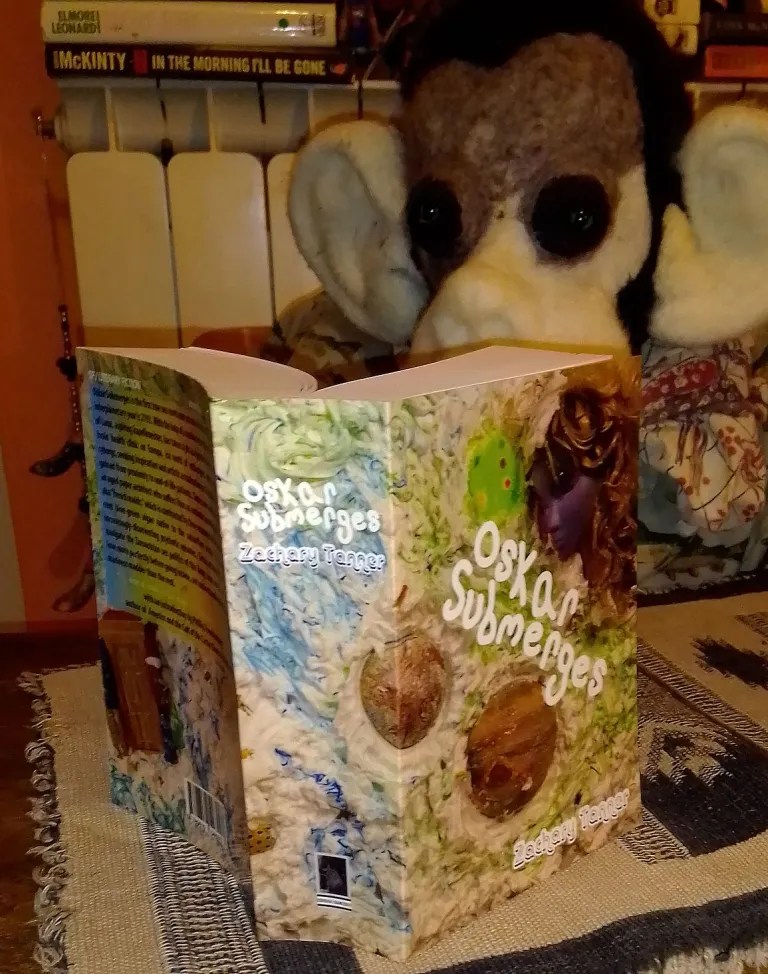
From the cover letter that failed to find a North American publisher:
Oskar Submerges is the first true sea novel ever set on a Jovian satellite. The interplanetary year is 2193. With the help of a massive inheritance, Cletus II of Luna, aspiring kapellmeister, has taken a job as a janitor in an infamous brain health clinic on Europa, ice world of entheogens and polysexual cyborgs, seeking inspiration and artistic actualization in the abjection to be gained from proximity to end-of-life patients. Cletus soon befriends Oskar, an aged paper architect who suffers from an endemic neurological disease, aka “french maids,” which is contracted by those exposed to the bioluminescent blue-green algae native to the subsurface ocean. In a series of increasingly-disorienting psychotic episodes, Cletus attempts to ethically navigate the Zoroastrian sex politics of this kinky new world and learn to love more perfectly before going insane, not understanding that love is the madness madder than the rest.
To order, contact my publisher: https://coronasamizdat.com/2021/08/29/oskar-submerges-by-zachary-tanner/
There is also a seven and a half hour playlist that accompanies the text available at:
PRAISE FOR OSKAR SUBMERGES:
“I haven’t read many sci-fi authors, but “Oskar Submerges” evokes two I have, Samuel Delany and Ursula LeGuin, in its treatment of pansexuality and utopianism. Set in the 2190s, the novel has a 1960s vibe—drugs, free love, self-actualization, “a hint of incense and peppermints” (p. 177)—but the quest for love and artistic fulfillment dramatized here is timeless. It’s a treat for music lovers: the bildungsromantic protagonist is a composer, so music references abound. (In fact, “Cletus at the Clavichord” would have been an apt, Wallace Stevensian title for the novel, though it can’t beat Tanner’s original, Kilgore Troutian title, “French Maids of the Conamara Chaos.”) Another treat is Tanner’s prose, which, like Cletus’s taste in clothes, “blended the sleek latex sensibilities of today with the excessive rococo frills, spotted fir, and peacock plumes of baroque times” (p. 403). Add cosmic vistas and a guitar-slinging bisexual cyborg named Ophelia and you have a winning novel.”
-Steven Moore,
author of The Novel: An Alternative History (2 vols.) and My Back Pages.
“In Oskar Submerges, Tanner euphorically erects a literary, utopian, space-opera superstructure, where we, as human beings, may once again experiment with imagining a world in which “otherness,” in this case, is possibly experienced as an extra-terrestrial, transhumanist, science fiction game theory, where the long unknown, culturally distanced “other,” once again through the experimental vision of this novel, instead becomes a sphere of pure love and beauty, where individual readers or we, as a species, bear the responsibility to learn how to transcend the oftentimes fearful isolation of our own primitive singularity to discover that truth and real human connections often arise in complex forms other than our own. ”
-Phillip Freedenberg,
author of America and the Cult of the Cactus Boots: A Diagnostic
 Zachary Tanner Bibliophile