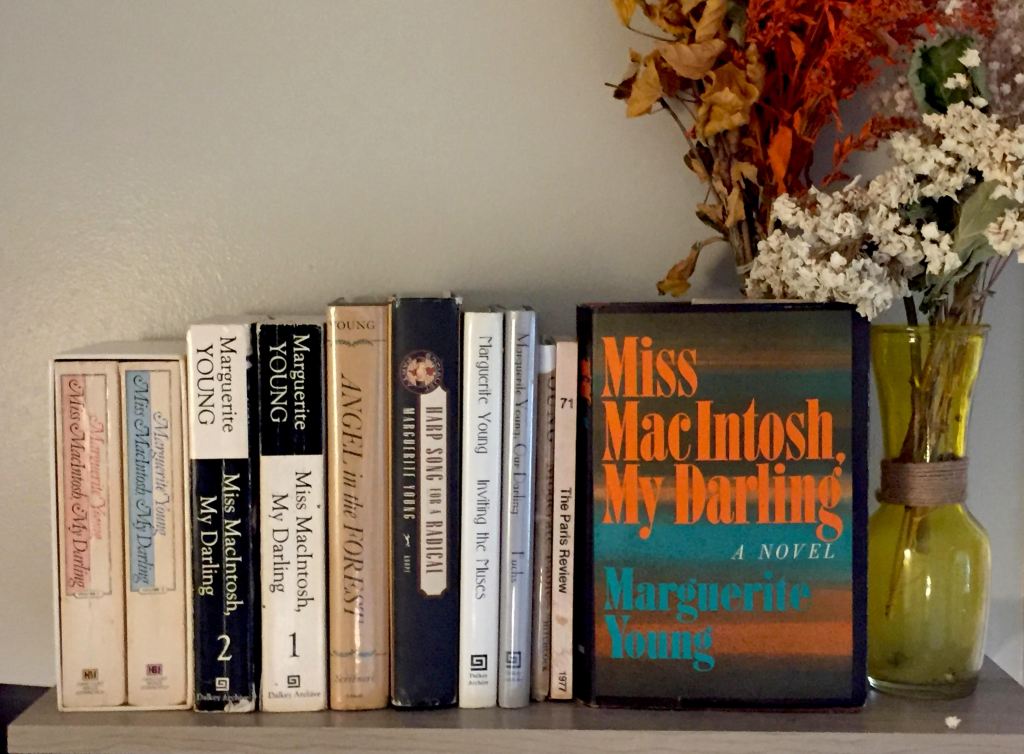
My essay on Marguerite Young was published in March 2021 on The Collidescope and can be read for free at https://thecollidescope.com/2021/03/21/marguerite-young-and-miss-macintosh-my-darling/
“Beyond its tedious pacing and repetitive syntax and imagery, “this transforming sea which changed all bodies and knew no walls, no limitations,” Miss MacIntosh, My Darling is a book that seems more concerned with constructing the space and time of consciousness than it does with illustrating a plot. Novels that do this particularly well, such as Anna Kavan’s Ice (1967) or Samuel R. Delany’s leather-daddy epic Dhalgren (1975), are usually shelved in the SF section. However, its preoccupation with the weight of non-being, its pluralist social politics, popcorn sentences27 like Vollmann’s You Bright and Risen Angels (1987), her impeccable use of Flaubert’s pluperfect mode (the pluperfect is the tense of most imagination and memory, for such is the mind that it folds in on itself, like layers of transmuting flower petals opening and bleeding into one another in a rainbow synapse of personhood within the skull, the body nothing but the birth of a dead skeleton, something that would only happen for a time), and the relentless omnipresence of what seems common in the universe but rare in literature, that is the Obliterative Sense, together ensure that this book transcends gender and genre, no matter how fun it may be to think of it as a Women’s Classic or literary speculative fiction, especially given not a little bit of our, what was it?, “galactic realism”: “The creation was not the stars. The mother of creation was this great abyss swallowing moons, suns, stars, city lights, cities, long-haired water lilies fringed by golden ripples under dying moons. Orion flying as if it were a bird. The creation was this void where the stars went out like city lamps.”

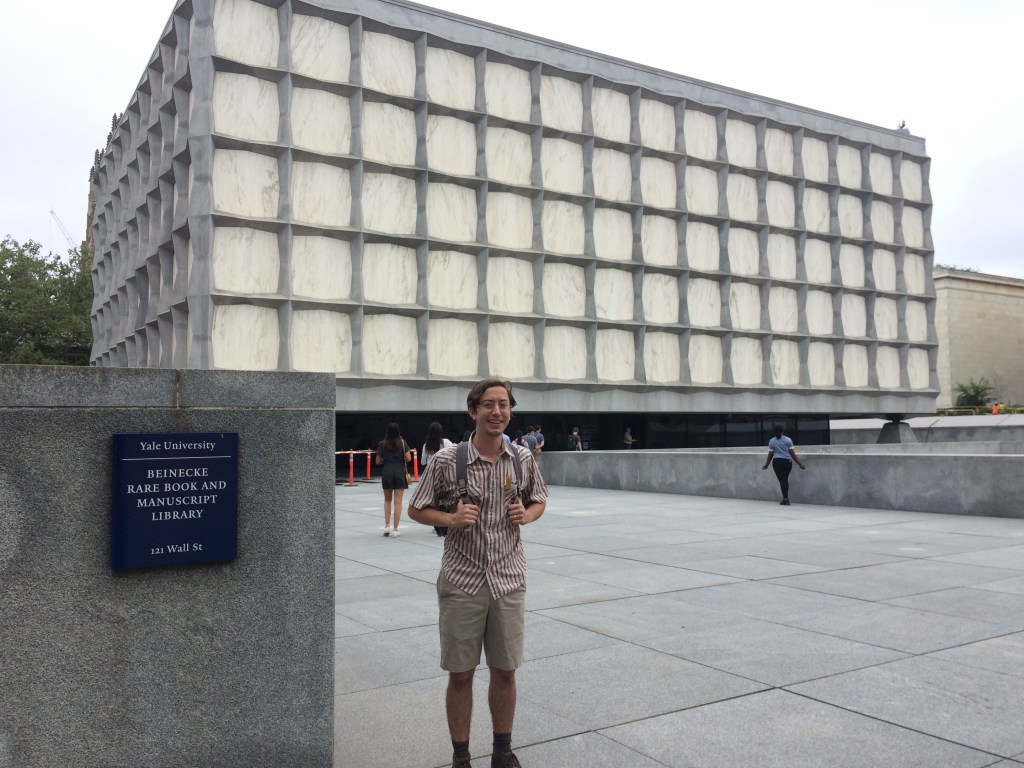
In front of the Beinecke Rare Book and Manuscript Library at Yale the day I visited Marguerite’s archive
 Zachary Tanner Bibliophile