Inspired by Thomas Pynchon’s uncharacteristically-candid introduction to Slow Learner (“You already know what a blow to the ego it can be to have to read over anything you wrote 20 years ago, even cancelled checks.”, p. 3), I thought in lieu of an about me page, I might share some unpublished writing and pictures that might showcase how busy I was during the first eight years of struggling to be a fiction writer, what kept me busy while I was busy getting interminably rejected from (in no particular order) The New Yorker, CONJUNCTIONS, Strange Horizons, Apex Magazine, Fugue, Glimmer Train, Ninth Letter, Bayou Magazine, Gulf Coast, One Story, Harvard Review, Black Warrior Review, Ploughshares, The Collagist, Triquarterly, AGNI, The Gettysburg Review, december, Blue Mesa Review, A Public Space, New England Review, Crazyhorse, The Idaho Review, The Kenyon Review, Nashville Review, River Styx, Nightmare Magazine, Analog, Asimov’s, Ruminate, Salamander, Boulevard, Oxford American, The Baltimore Review, Oyez Review, Arts & Letters, Zyzzyva, The Southern Review, The Yale Review, Lake Effects, A-Minor, Brevity, et al.
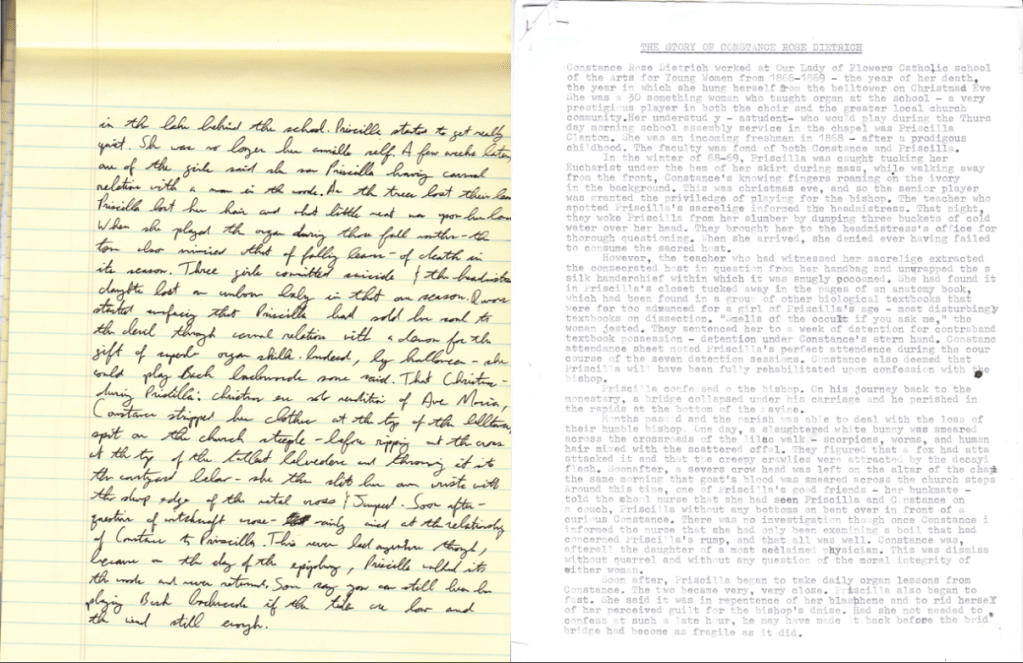
THE HAUNTING OF CONSTANCE ROSE DIETRICH
The following is the cover letter I wrote in 2015 to my undergraduate film school Capstone, which was a feature length horror screenplay.
I.
On any given night in 2013, from January to December, there was a horror movie at the theater – or so it seemed. I must have gone to the theater weekly. Though, I wasn’t seeing Frozen, or Gravity, or 12 Years a Slave. I was spending all my money on Insidious: Chapter 2, and The Purge, and that Carrie remake best left forgotten. I saw most of them twice. Some, like The Conjuring or Evil Dead, I saw five times. I was insatiable, both at the box office and in cyberspace.
I fell in love that year. Alucarda (1977), Freaks (1932), and Let the Right One In (2008) – these movies are tonal masterpieces, and I wanted to be the audience they deserve. Others, like Nosferatu (1922), Suspiria (1977), and The Cabinet of Dr. Caligari (1920) were simply fun to look at. I discovered Bava and reacquainted myself with Cronenberg. I must have watched The Shining (1980) a dozen times. It was bliss.
And at some point, I said eureka.
As a kid, I loved horror movies because they made me reevaluate reality on a surface level. Experience told me my third grade teacher picked up her kids after school and had a big dinner already prepared. They would eat and laugh, tucked away in a cozy nook around the feast. How merry they would be. But horror movies made me ask: Is she starving? And are her kids starving too? Maybe after a long day, she brought them to the morgue instead. She was a cannibal, obviously. I could see it in the rouge of her gums. Maybe she taught her kids to love flesh too. And, presumably, they wouldn’t have any complaints other than not wanting to brush their teeth that night – fighting their mother by saying, “But I don’t want to wash the old ladies perfume off my tongue. She tasted so… delicious,” and then, stomping, “You never let me have any fun.”
I could speculate like that for hours as a child. And I suppose that’s still true of me. I was more repulsed by the smiling, nurturing faces around me than I was by something like the first scene in Children of the Corn (1984) where the young children murder an entire diner-full of adults for no apparent reason. Happy people made me want to vomit. I despised their quotidian cheer. I wanted to see them scream. Although it wasn’t until just a couple years ago, that I ever started asking myself – how?
As much as I enjoyed watching horror films and listening through headphones with my back to an open door in a dark, empty house, they were never something upon which I could reflect. That is, until I saw Insidious: Chapter 2. During a particularly revolting scene in which they find fifteen or twenty corpses beneath white sheets sitting in church pews behind a bookcase in a haunted house, I had a breakthrough. The Bride in Black, Parker Crane’s murderous alias, seemed familiar. Don’t get me wrong – visually, it is just plain creepy. But, there was something about the image of an old hag in widow’s weeds that really seemed to strike something deep down, the slack string on an out-of-tune cello deep in my gut. Was it because the mourning attire symbolized death? No. Was it because in this case that old hag was actually a creepy old man in drag chopping people up into little bits? No. What was it?
It was recognizable. That’s why it was unsettling. I had seen this before. Had I, like Josh Lambert, also been visited by this old woman when I was a small boy? No. I had seen it not in my own life, but in The Woman in Black (2012). And in The Woman in Black (1989). And in House on Haunted Hill (1959). And in Black Sabbath (1963). And in Dead Silence (2007).
For the first time, I realized that the genre’s capabilities reach far beyond the recycling of tired tropes. A trope can be more than a plot device or a circumstantial anecdote. One trope or archetype, on its own, is simply cliché. If a few or more are used simultaneously or at the right time, one can achieve not only an atmosphere universally disquieting to the well-versed horror audience, but also achieve intense dramatic irony that gets away with using the genre, rather than the antecedent events in the story, for this effect.
II.
When I started working on this script back in January, I was having some real trouble coming up with an idea I felt was not only worthwhile, but invigorating. I was researching for hours each day. The books I read during the conception of this story include:
-Syd Field, Screenplay: The Foundations of Screenwriting
-Paul Chitlik, Rewrite
-Oliver Sacks, Hallucinations
-Brian Levack, The Witchcraft Sourcebook
-David Konow, Reel Terror
-Jason Zinoman, Shock Value
-Edited by Chris Rodley, Cronenberg on Cronenberg
-Stephen King, Danse Macabre
My research, as one can see, included everything from the history of the horror film to the history of the “nightmare” myth, closely associated with the phenomena of sleep paralysis, on which I draw heavily in my story.
I wanted to write the kind of film that teeters between the credibility of the protagonist’s psychosis and the very real possibility that in the world of the film, the supernatural may exist. The protagonist may not be crazy. I also knew that I wanted to utilize the same kind of intertextuality that James Wan embraces in all of his movies. I wanted this movie to toy with the expectations of genre die hards – like Fede Alvarez is able to do in Evil Dead (2013). I wanted to let the narrative do the work of instilling horror in the reader rather than relying time and time again on trite jump scares – though a few of these have found their way into the finished script.
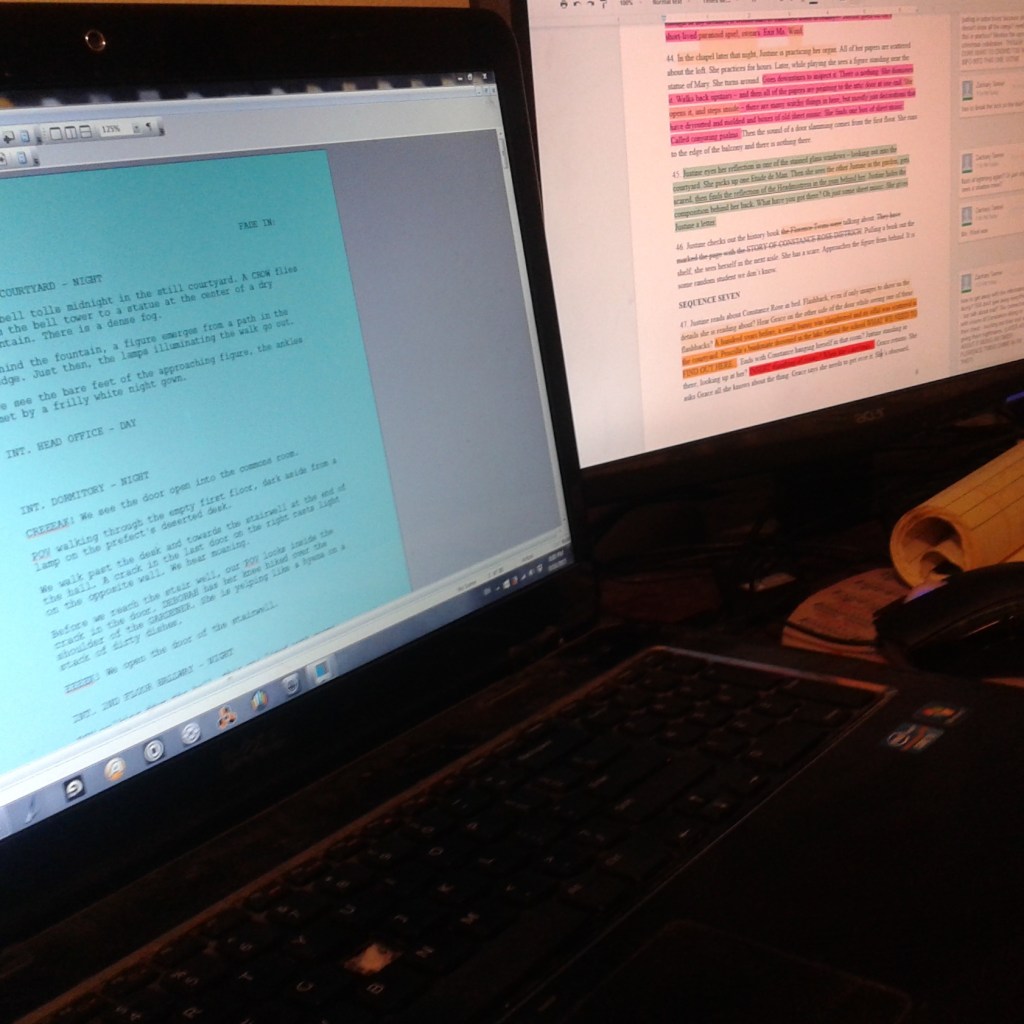
Abstract ambition – that’s all I had going for me. I knew in what ways I wanted to critique the finished product and pat myself on the back, but that is no way to create art. So what did I do? I bought a couple yellow legal pads and started asking myself questions – lots of questions, and not necessarily giving myself the answers. By interviewing myself, I plumbed the depths of my research, hoping that certain fragments would coalesce and I’d end up discovering a story to tell rather than simply making one up.
My voracious viewing of both genre classics and genre tanks continued throughout this time. I was under the impression that if I oversaturated my head with horror history, I would be able to triangulate my own take on the genre simply by allowing taste to tell me what not to write.
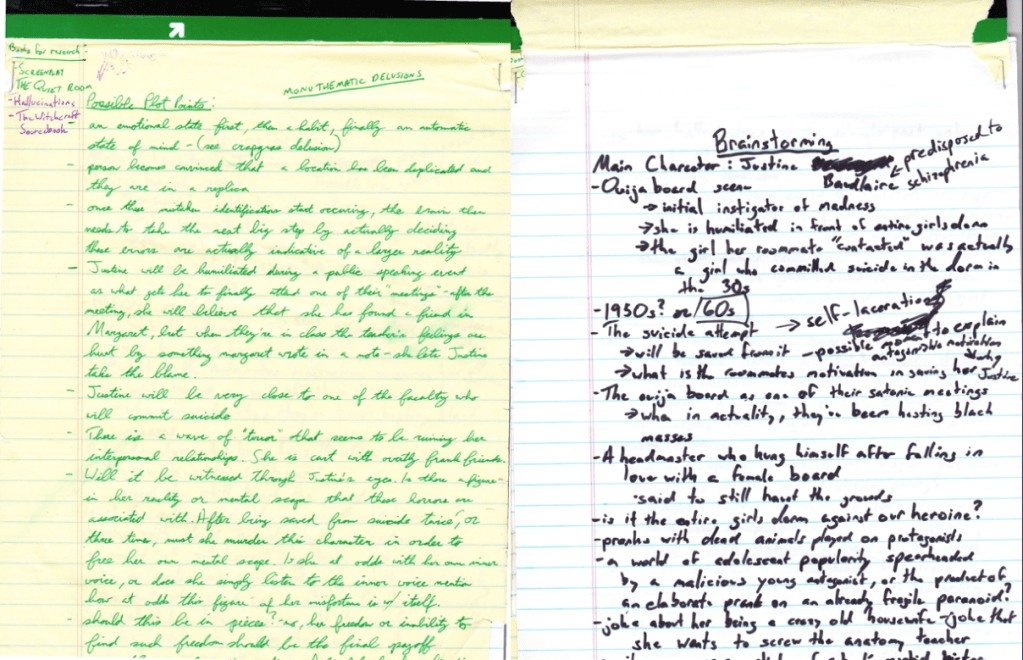
Soon enough, I had full legal pad painted with questions. And somewhere within those pages, I had found my story. My plan had worked. In reading Hallucinations, I was immediately drawn to both the phenomenon of autoscopy and the phenomenon of sleep paralysis. One of my better ideas was to combine these two. Many of the witchcraft elements were compounded from various stories in The Witchcraft Sourcebook.
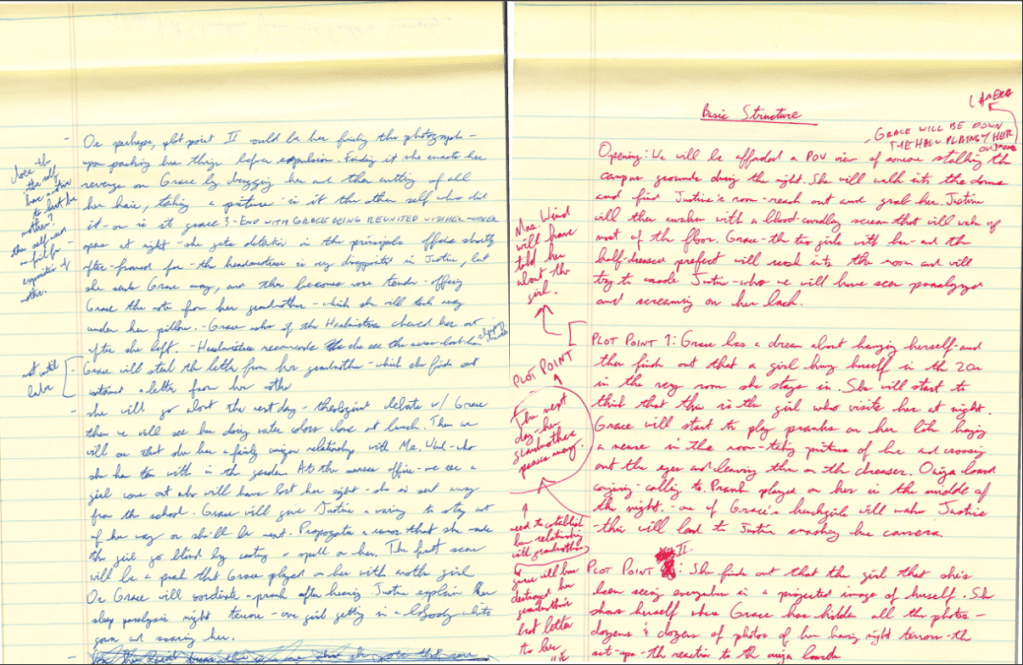
Aside from these details, however, much of the story’s components come from my favorite horror films. I did not notice this until after I had written the first draft. I knew that it was my intention to really exploit the genre, but I had no idea in what way I was going about it until it came time to revise. Justine is a young organist suffering awful hallucinations, reminiscent of Mary Henry in Carnival of Souls (1962). She is going to an all-girls school of the arts, similar to the ballet academy in Suspiria (1977). Unintentionally, the introduction of a malicious POV at the beginning of the film nods at Halloween (1978). The death near the end of the first act uses one of the big tropes: sex is dangerous in a horror movie. The fact that this scene takes place on the edge of a lake may call Friday the 13th (1980) to the minds of some, but I’m almost sure its inspiration is the pier scene in Bay of Blood (1971). There is a scene in which Justine’s doppleganger drops a mouthful of rancid water into her mouth. This is one of the few homages I recall consciously including (see Fede Alvarez’s Evil Dead). The Florence Twins resemble the Grady twins. The elements involving Catholicism at once call back to Rosemary’s Baby (1968) and my own private education; although, it seemed an obvious jump from having an organ prodigy as a protagonist. The dream sequences acknowledge at Polanski’s classic, however. I even found the archetype of the old woman in the black dress that had sparked my interest in Insidious: Chapter 2 in the form of Jacqueline, Justine’s grandmother.
Most of the above elements are fairly small details in the story and only set the stage for the narrative being told. They are atmospheric tropes more than they are narrative tropes, which is why I don’t feel at all ostentatious in listing them here. They really don’t do much for the story other than satisfy a certain type of horror viewer’s craving for easter eggs. It is pure aestheticism. However, such archetypes as the gothic heroine or the ouija board as medium for talking to the dead – these are elements I felt that I was only allowed to include if they used our genre expectations for or against us.
III.
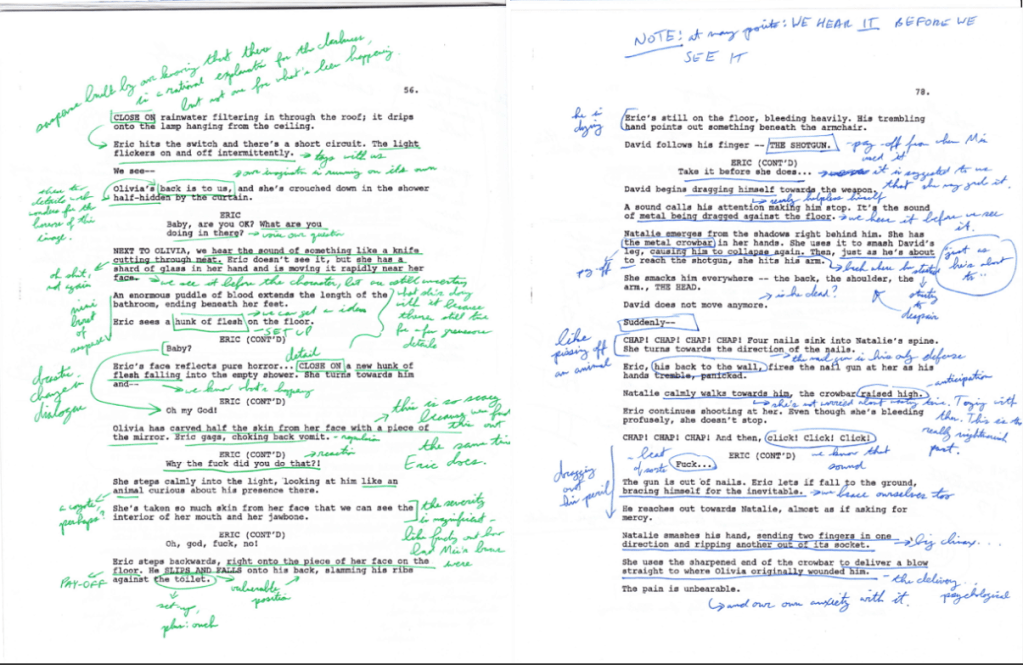
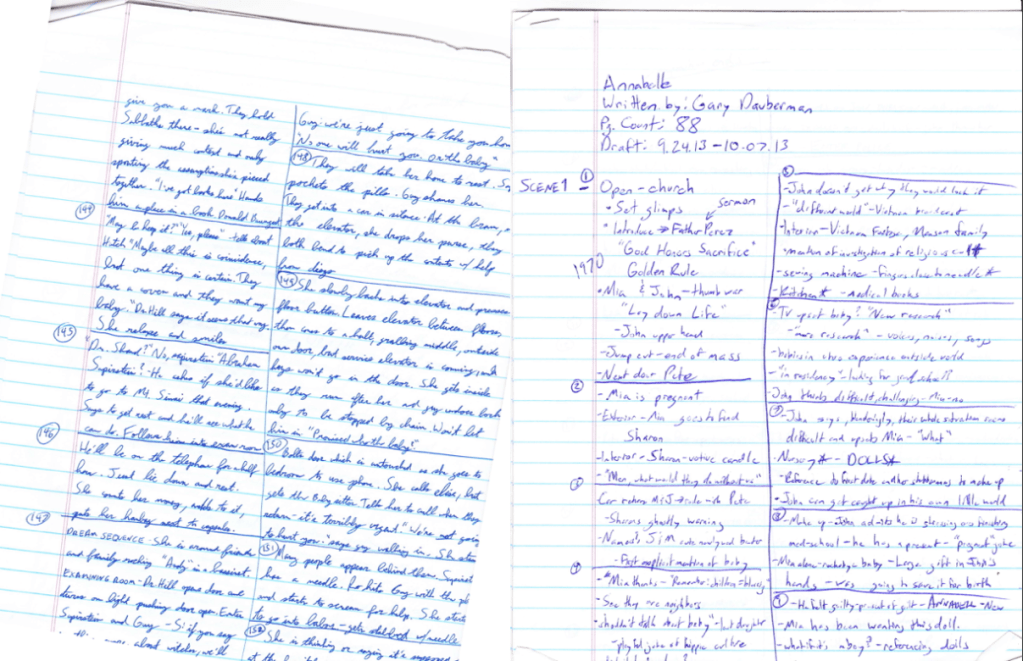
The most valuable stage of my research was the profuse annotation and dissection of some of my favorite scripts. I printed and took a pen to PDFs of the scripts listed below. I tried my best in each screenplay to make notes of: the basic three act structure, homages to other films, grammatical and formal nuances, tactics for building tension, use of dramatic irony, pieces of dialogue particularly telling of a character’s idiom, and each set-up and pay-off with page numbers referring to a moment’s related scene or snapshot. By doing so, I hoped to end up with a cinematic style akin to the films I was obsessing over. They include:
-Roman Polanski, ROSEMARY’S BABY
-Jane Goldman, THE WOMAN IN BLACK
-Fede Alvarez & Rodo Mendez, EVIL DEAD
-Leigh Whannell & James Wan, SILENCE (aka SHHH)
-Chad & Carey Hayes, THE CONJURING
-Sam Raimi, BOOK OF THE DEAD
-Gary Dauberman, ANNABELLE
-Mark Heyman & Andres Heinz & John McLaughlin, BLACK SWAN
-John Carpenter & Deborah Hill, HALLOWEEN
-Matt Reeves, LET ME IN
-Joseph Stefano, PSYCHO
What I learned during this process was invaluable. For one, I intuited the cinematic language used in screenplays after the fifth or sixth script. This was important, because by doing so early on, I was able to spend most of my time on story. I find it quite like a poem, a villanelle or a sonnet perhaps – something with a strict form. The emphasis is on sensual imagery, so the use of the simple present is a must. Through my revisions, I kept cutting down the language more and more – both action and dialogue. If the image is the ideal, one must be terse.
There were other little tricks I was able to pick up that have found their way into more contemporary screenplays. In BLACK SWAN and ANNABELLE, I found that when a continuous action begins in one room and ends in another, it is acceptable to simply write the LOCATION for a slug-line. I used that one a few times in my script. This kind of formalism influences the way the reader will see the story in their mind more than language ever could. From EVIL DEAD, I lifted an interesting technique in which the items that are later important to the plot are given subtle emphasis beforehand. Early on in that script, our attention is focused on a reciprocating saw cutting through a juicy steak. Initially, this seems frivolous, but when one of the characters later uses the same saw to cut off her arm, it becomes a set-up.
When I read through these scripts, I finally started to grasp how important using dramatic irony is in the horror film. Think about moments we’ve all seen when we catch a glimpse of the thing walking across the hall behind the protagonist’s back that vanishes just before they turn around. Think about those moments when the soon-to-be-murder-victim opens the door to the closet where the creepy sound is coming from. Those in the audience will shout, “Don’t do it, you stupid f-.” Some viewers will bite their nails, softly squealing, “Oh please don’t do it.” Why exactly is this scary? I think it has something to do with the fact that, as an audience, we know we’re watching a horror movie, and we’ve seen enough to know which rules apply. Indeed, when a character’s back is turned to a long hallway, we expect this kind of dramatic irony. There isgoing to be something standing behind the shower curtain when a character slams the mirror above the sink shut.
It’s gotten to the point where the only thing scarier than there being something behind the shower curtain is when the character closes the mirror and there is nothing there. The filmmakers have toyed with our expectations. It engages us with the narrative at the same time that it instills unease within us. We know when this happens that it won’t be long before some kinetic scare follows. Even if the resulting jump-scare is afforded by a harmless character, we still scream.
In many ways, I tried my best to play with the expectations of the audience in this way. I had a lot of fun with the mirror trope in particular, putting it in a fresh light by using an organ mirror to this effect. Though, this is a more minor and sparse utilization. To explain what I mean more fully, it would be useful to talk about the first Ouija board scene that takes place on page 14 of the screenplay. I utilize many different conventions in unison. For one, the Ouija board in many movies is a direct link to the supernatural world. From The Exorcist (1973) to Paranormal Activity (2009) to the simply titled Ouija (2014), we have seen this game enough times to know that it is not to be taken lightly. We know it is going to work as a bridge to the other side. However, in this scene, we believe that Becca and Grace might be trying to scare Justine in retaliation for a misunderstanding, so we are forced to be skeptical. When we cut to Deborah and the Gardener running to the pier in the pouring rain, we become skeptical of our skepticism. Not only does this cross-cutting immediately establish a correlation, as per the Kuleshov effect, but the couple begins to get frisky. From this point on, we know something is going to happen. Sex is suicide in horror movies. Some girls nearby are playing with a Ouija board. The school has a history of supernatural occurrences. There is only one possible outcome: someone will die. And someone does. Personally, I’m still fairly ambivalent as to whether or not there is a supernatural connection between the Ouija board and the death in this scene, but I’ll leave that for the reader to decide, so as not to give too much away.
IV.
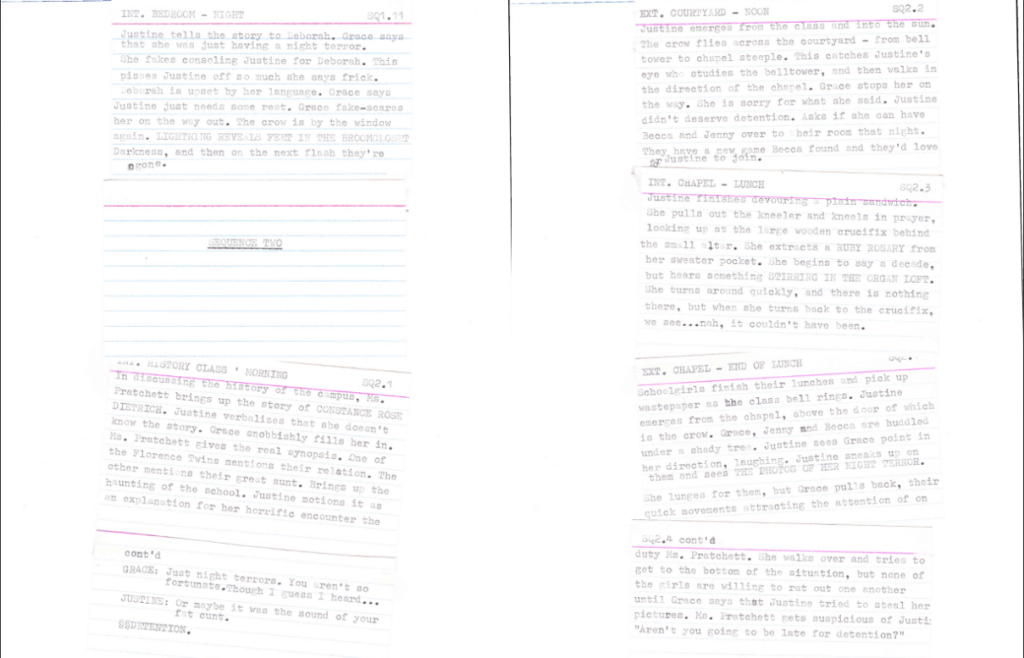
What follows is the fourth draft of my screenplay, completed November 20, 2015. The story has come a long way since the disjointed notecard-draft that I completed in March. The first three drafts are substantially different from one another, whereas the fourth is just a tidy revision of the third. In reading over my first full draft, (finished June 4th), I spotted many extraneous narrative elements that called for unnecessary additions to the budget. For example, there was a character, Jenny, who was best friends with Grace and Becca, that didn’t do anything at all. In no way did she affect the plot or take a significant role in any subplots. I cut her. There was also a kind of rhythmic return to establishing shots of a great clock tower, a la The Phantom Carriage (1921). It didn’t do anything for the story and it placed restrictions on the possibilities for locations. I cut it. There were a couple scenes that unintentionally mirrored early scenes in the story. I cut them, and made sure that when I did write a scene that called back to an early scene, it was a set-up and pay-off scenario.
The second draft, (finished September 25th), accomplished a complete reworking of the language. Only about 10% of the text of the screenplay remained the same after this stage. I focused primarily on structure, staggering the story into roughly eighteen distinct sequences, each containing anywhere from three to fourteen individual scenes. When I was finished, I had a much cleaner version of the first draft.
The third draft, (finished November 2nd), was by far the most successful yet. Working with the bare-bones second draft, I focused on the motivations of the characters. This was when I had many of my best ideas. In the early drafts, Justine is the one visited by the nightmare in the opening sequence. In this draft, Grace was now the one visited. This is when I came up with the evil melody that slowly works its way into the story and ultimately becomes Justine’s means of revenge. I was able to successfully work in the concept of the witchcraft causing the girls she practiced it against to lose hair, teeth, and sanity. In this draft I solved the problem of the Florence Twins knowing so much about the story by making them ghosts. Initially, I had written it in a manner where this was merely suggested, in a way where one also saw them eavesdropping all the time. In this draft, I cut out a couple different conversations Justine was having with them so that now their presence is predominately limited to the second act. This was done in hopes of minimizing campiness. Children of the Corn (1984) and Sinister 2 (2015), the latter drawing heavily from the former, both make the mistake of putting the viewer in too close a communion with dark forces. When this happens, they seem goofy and laughable. I wanted something closer to the spirits that Jack Torrence interacts with, such as the bartender or the bathroom attendant.
What follows is the script I have been trying to write since my epiphany in 2013. It is the script as I imagined it back in January, though not necessarily the same script I then conceived. I now proudly present: The Haunting of Constance Rose Dietrich.
STICKY-SHED
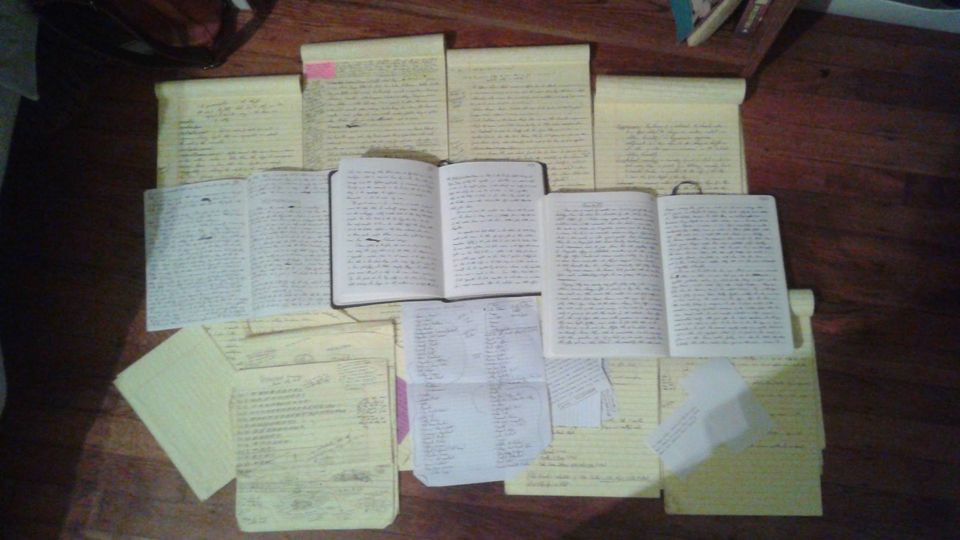
My abandoned novel Sticky-shed spread open.
I explained this one to a friend in an email recently, the only time I’ve really spoken to anyone other than my wife about this novel, and rather than phrase again what need only be said once, I will cc you all:
There is actually a third novel (together those I’ve mentioned are the only three) that I wrote during my four-month honeymoon in Peru called Sticky-shed, the whole metaphor of decay around which it is based coming to me when my dad tried to play a tape that had been sitting in his four track for thirty years through all kinds of conditions and power outages and as soon as it went through the heads, the machine started spewing off chewed bits of gummy tape, which stuck to the ceiling, the walls, the machine. It made a big impression on me. With a little bit of research, I learned about tape baking and became obsessed with the concept. Funnier still that it’s a novel I’m not sure I would “let out of the house.” Pessimistic, histrionic semi-autobiographical memory narrative about Obsessive Compulsive Disorder. I completely understand the sentiment. I don’t want anyone to see that book, and yet I haven’t had the gumption to destroy it, and likewise have sometimes taken pains to preserve it.
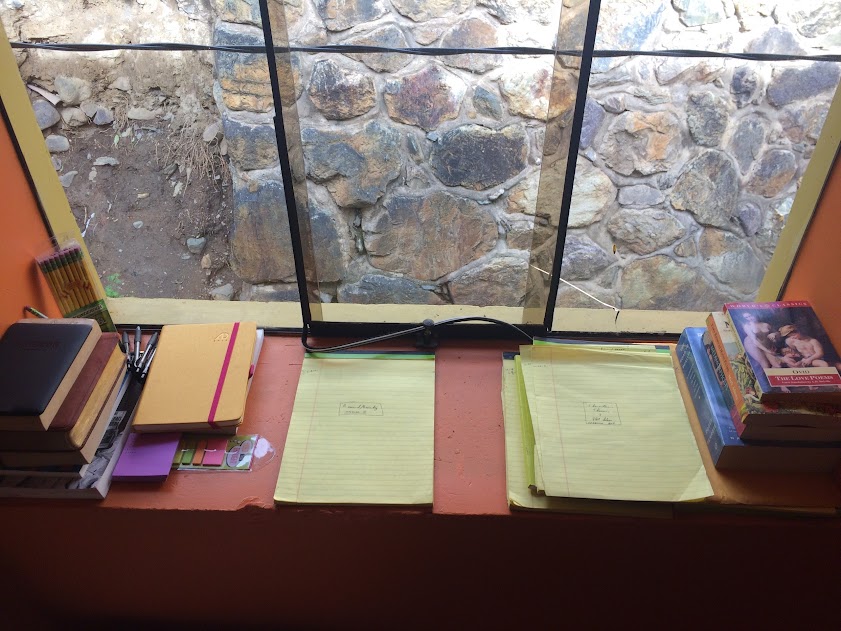
The window ledge I used as a desk in Peru.
And the view up to the left if one sticks one head out of the window:
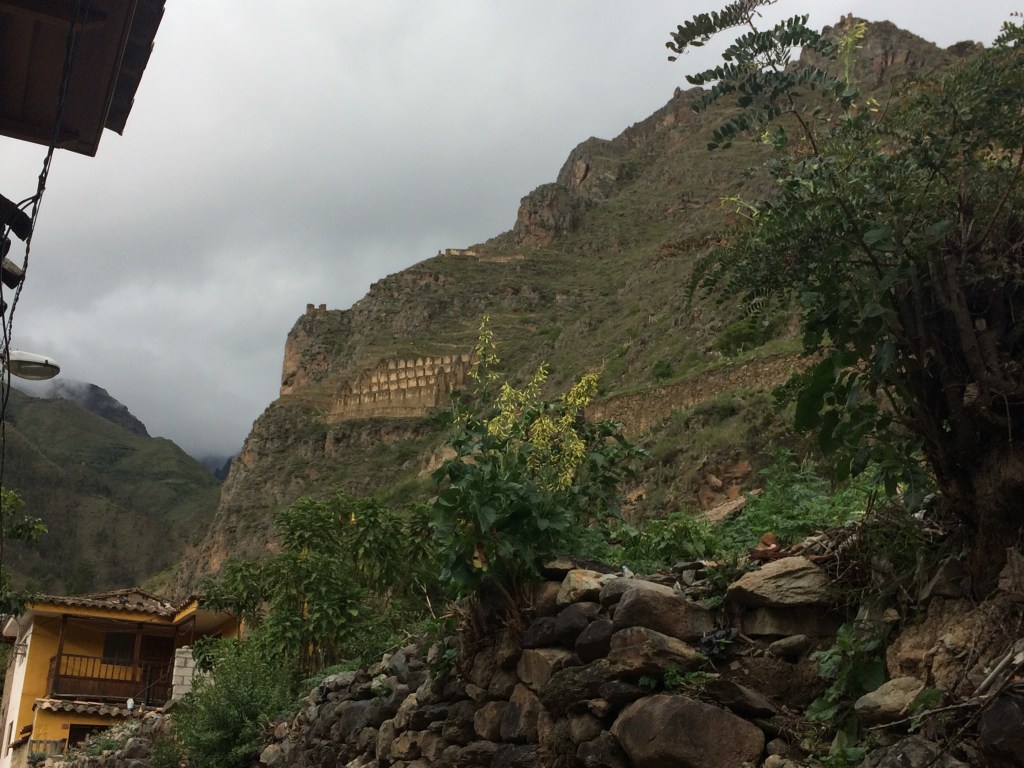
The apartment is still owned by the family who generously put my wife and I up in exchange for hospitality labor and English tutoring and can be booked at https://www.facebook.com/YeluxApartment/.
And finally, an excerpt from my never-to-be-published semi-autobiographical bildungsroman, Sticky-shed, titled “Baking Tapes”:
I. White Linen Gloves
I called Paul that evening beneath an orange sky spotted with purple clouds and penciled by the stark white of jet trails so high in the atmosphere that they still caught direct sunlight. I could hear him loading his instruments. “I’m just leaving my church gig, what’s up?”
Shortly after I knocked on his door, we moved the bulky tape deck, the CRT monitor, the box of tapes, and a case of IPAs from the back seat of my Honda to his kitchen table. I knew from rooftop cigarette breaks and from his periodic absences that he was a touring musician and an audio engineer, but I didn’t expect Paul’s house to be a bungalow floor plan utilized as a full music studio with foam paneling and an intercom system for talk-back from the control room, which had once been his bedroom, one wall of which had been replaced with a glass panel from the wainscoting up, looking in on the keyboard room. I marveled at field stripped organs, Leslie speakers, electric pianos, Moog synthesizers, tube amps, microphones, hand-made sound panels, milk crates of cables, and guitars hung on hooks. I admired a doodle on the refrigerator of an alligator playing a keytar on a stage, which had been cut from a piece of notebook paper and painter’s-taped to an illustration from Henry Darger.
Paul opened his beer with a Bic lighter, “That was the cover of our first EP.”
“I brought the manual for the recorder, too, if we need it.”
“We shouldn’t. So you put one of the tapes in. What happened before it got stuck?”
“The image started breaking up and turning colors and tracking like hell and went monochrome and cut out and came back in, then it turned spotty, the tape squealed, the machine locked up, and I couldn’t eject the tape no matter how many times I pressed eject.”
I sipped bitter hops and watched him unscrew the top panel of the Panasonic NV 9800. He revealed the big silver drum around which was held in tension the slack of the jammed tape in the shape of a U, the tape transport surrounded by a little city of capacitors, the guts bared like a frog with breast flaps open. “She’s beautiful,” he said. That afternoon, I had peeked under the hood, humbled by what I had found, overconfident from all those years getting jammed VHS tapes out of VCRs at Lafayette Video. I realized how unique these machines are, that I only trusted my tape in trained hands.
“This thing has two channels of audio? Sick. And manual audio and video levels? This is quality shit, huh?”
“The guy who gave it to me said that he got it from the TV station he worked at. The camera I have recorded to these twenty-minute cassettes and I used this thing to record those to hour-long tapes.” My legs were shaking, and I couldn’t think of anything when I started twisting and pulling my hair other than how nice it felt to twist and pull my hair. “So if we get the tape out, what are our options?”
“If we get the tape out and the machine cleaned up,” he scratched the back of his shaggy blonde hair, stroked his goatee, stepped onto the back porch, and lit up a Nat Sherman, “How long has it been since you used that thing?”
“I don’t know. Maybe seven years.”
“Yikes.”
Paul’s overgrown backyard was spacious, yet none of that room was wasted, as there was an ice cream truck, a wooden shed, a coy pond, bamboo, dead banana trees, and an enormous pecan tree, the roots of which had begun to crack the concrete walkway from the back porch to the pond. The branches blacked out a veiny web of the light-polluted sky. Wind chimes rang in low-hanging branches.
We entered the ice cream truck through the back door and walked over red shag carpet. It was surprisingly homey: a hammock, bookcase, acoustic guitar, and reading chair lit by icicle lights hung in rows from the ceiling. “When I turned the house into a studio, I needed a place to sleep.” He set me up in the driver’s seat, allowing me to work at a wooden desk that had been installed where the dashboard once was. The workspace looked out onto the brown banana trees. “Assuming I can find a way to get this cassette out and clean off the gummy residue, we’ll have to make sure there aren’t any corroded capacitors or loose belts. If there’s a problem with the motors, we’re looking at a lot of man hours, especially considering I’ve never worked on one of those. If the deck is screwed, then we’re fucked. If by some miracle it isn’t and we can bake the tapes and fix packing issues, then if you’re lucky you might be able to migrate.”
In a manic rush Paul ran back to the big house. I stood with my beer in one hand and my box of U-Matics under the other arm. He returned with a space heater and the metal panel from the back of his Tascam, which he set in the middle of the carpet. He exhaled smoke, flicking an ash out the doorway, “I’ll try to get the recorder working. You get to work on cleaning the mold. There are Pellon swabs in the little red drawer labeled miscellaneous right in front of you and isopropyl alcohol in the blue one.” He pointed with his cigarette-holding fingers at the little box of color-coded drawers before me. “I have a mask somewhere around here too. If you finish cleaning those and need something else to do, you should look up what format we should dub to, if you don’t know already. We could line out to digital video and then migrate to the computer, right? Also might want to see what other hang-ups to expect, yadda yadda, though I expect we’ll have plenty as it is. Don’t forget to swab both sides of the tape.”
Worried beyond comprehension, I twisted the hair above my right ear around one finger. The wind made the windshield creak against the rusted metal frame of the ice cream truck. I made room to work by pushing aside a soldering iron and a couple gutted guitar pedals. As I put on my white linen gloves and pulled the string of the desk lamp, I glanced at the poster tacked to the wood-paneling, the infamous print of Frank Zappa on the toilet.
II. ¾” U-Matic
I found out that my tapes were damaged only after I had developed the acute fear of outliving them. My position at the Center for Louisiana Studies entailed telecine work with 8mm, Super 8, and 16mm prints, migrating video to digital formats, restoring photographs, separating acidic paper from non-acidic paper, and creating entry after endless entry of metadata in our cataloguing software, so for some time before my awful discovery, I had garnered a deep fear of the ephemeral nature of moving images.
That morning Paul had poked his head through the door of the video lab and had asked if I wanted to learn something about Ampex tape. When I walked around the partition, he was picking up the pieces from an audio reel of Justin Wilson from the seventies, the back-coat having shot off in flakes of glossy black, some pieces stuck to the walls, where they clung so tightly by static electricity and gummy residue that we could not scrape them off with a credit card, pocket knife, or other bits of flaky tape. He explained that sticky-shed syndrome was to blame, that the binder and back-coat of some old tapes, when stored in wet, hot conditions for any amount of time, will separate from the magnetic layer, releasing iron oxide, leaving a grey-black residue on the heads and tape guides of the recorder. With the white fuzz of a cue tip he pointed out the areas that would now have to be cleaned. He was explaining the process of baking tapes when I grew distracted, as being spoken to will sometimes trigger an uncontrollable stream of images, memories, and daydreams in my mind’s eye, in this case the flash of those years the tapes and manuscripts had spent in the shed behind the little blue house I shared with Magnolia. I had naively planned to use her shed as a workroom, and there, they had weathered the heat and humidity of rank Louisiana summers. When we broke up just after my graduation, I brought them back to my parents’ house. I moved to a different city and from there a different continent and back, during which time Phoebe got married, Mom passed, Theo got remarried, and on countless occasions the power grid had been knocked out by squirrels, hurricanes, and drunk drivers, and each time the house had grown sticky and hot—not to mention when the entire downstairs was flooded with four and a half feet of the Vermillion River, how we had to throw away the bedding, clothes, curtains, and upholstered furniture from upstairs, too, because nothing in the house ever smelled quite the same after that.
I couldn’t think about my work at the archive for the rest of the day. As soon as I got off, I drove to my dad’s house. He was gone, thankfully. I used my key to get in, bound up the carpeted stairs in the foyer, and started hyperventilating at the threshold of my childhood room before I even had the moldy cassettes and silverfish-eaten screenplays in my hand.
III. Media Workshop 342
I could write an entire bildungsroman about Media Workshop 342. I was the only devoted pupil of the adjunct professor, Immanuel Bertrand, who doted on me for the entire semester because I had a conversation about Kurosawa with him after the first class and because sometimes we went to the same bars. I first developed a fascination with magnetic tape after Immanuel’s enthusiastic lecture on Nam June Paik’s “Random Access.” It was an experiment of sorts, with the audience as performer, audio tape pasted onto the gallery white, viewers encouraged to wave an extendable playback head like a wand over strips, reducing a time-based medium to chaos. I asked if it was okay if maybe I bought a Portapak, as Paik had famously utilized, and used it for my four video projects. He said that they were expensive and rare because they had kept an exclusive cult of users over the years, but he did have a Sony DXC-1600P, which shot on U-Matic cassettes, so it wasn’t reel-to-reel like the Portapak, but it similarly recorded to a portable camera control unit on a shoulder strap, the VO-3800P. He also had a larger recorder for editing, a Panasonic NV 9800. He said I could have all of it, if I really wanted to shoot on something obsolete. I grew romantic at the thought of being the only filmmaker in my entire college who shot analog, my artistic blossoming televised as a continuous signal, while others were fractured and quantized by digital code. I used the trigger-operated equipment for each of my four video poems that semester: Hot Excrement, Pantywhere, and Positive Feedback Loops 1 & 2. The unanimous success of the lot was Pantywhere, which was not lost on my classmates like some of my more formal experiments. It is the story of a single pair of panties over the course of months and years, shot one October weekend with the girl I had lost my virginity to the weekend before. The finished piece was set to “La donna e mobile,” because I’ve always found opera erotic, and consisted of a series of match cuts: the pink panties with little white bow being put on in the morning, hanging on a clothesline, dropped to ankles in front of a public toilet, hanging from a bare ankle outdoors during sex, tossed from the edge of her foot onto a pile of dirty clothes, tumbling in circular motion in the wash in extreme close-up so the motion of the frame was a vortex, balled up on the rim of a hot tub next to a sweaty champagne glass, and on and on it went with the narrative freedom of Slacker. It was a big hit with Media Workshop 342, especially once I explained that it was a metaphor for my OCD, the obsessive existence of a single pair of panties “whose existential duty is unchanging in the face of an existence defined by the juxtaposition of the beautiful with the grotesque.” After hearing my artist’s statement, Immanuel made the class watch it a second time. Those were the days when anytime I doubted my iconoclasm, I would flip through Cronenberg on Cronenberg for inspiration and would gaze at an early photo taken when the auteur was shooting From the Drain, using a two lights and a single camera. I knew that all it took to be a filmmaker was to make films, which I was doing. Immanuel made me believe that there was a purity to analog formats. This stuck with me, and I went on to shoot the only three hour-long films I have ever produced on it, a trilogy of interviews with close friends of mine à la Coffee and Cigarettes or Fishing with John.
My growing regret over the years since they were compromised has assured me that they were my best work. I shot them and never screened them, never edited them, never watched them again drunkenly late one night as I did some of my later digital experiments. They were like the text messages of an old lover which one keeps on one’s phone never to delete, yet never to read again either. If I have ever captured or created truth, it was somewhere within those three tapes, which now live only by the allusions of this memory narrative.
IV. One Little Wormhole
Just the other day, Jerome visited me, and he brought with him a rubber container of shatter and a Snoop-edition G Pen, which transformed my garret into a dreamy space lit like a Rossellini picture that I had once visited beyond time, in the heavy dark matter of my subconscious, and Jerome was this eternal friend, caught somewhere in the middle of a divine metamorphosis, one of Degas‘s ballerinas. After three dabs, I was an invisible floating orb of energy in space around my eyes. Phoebe was practicing her erratic Paganini cadenza in the music room two stories below us. I felt so anxious, because I had never gotten high while living on her graces, that I started to gag at the overwhelming responsibility associated with being an invisible floating orb of energy around a pair of seeing eyes, to the point at which I was not sure whether or not I had died and found that the other side was just as confusing, chaotic, and lonely as this side, that in death was no peaceful sleep. A careful sip of water brought me back down to reality, though for some time breathing was a conscious effort.
When I wheeled over from the octagonal window to my roll-top desk just now I intended to write a little more about my time as a projectionist, as a video store clerk, and as an amateur filmmaker, to tell you about the thesis I was writing on the use of color in Cries and Whispers, to explain how I met Paul and how I got drawn into the preservation internship because I was the only grad student studying art history with a passable knowledge of celluloid and videotape, so that with all of this in mind you might have a better portrait of who I was, but—from my new, elated perspective, under the influence of the concentrated THC Jerome so graciously left with me—who I was at the time seems a little less important than why I was afraid of losing the ephemeral traces of an earlier incarnation of myself. And so I digress:
The word ‘obsessive’ brings to most minds the watchmaker, the tinker, the landscape artist, the writer of novels of multiple volumes, this delicate finesse that allows the obsessive to deconstruct things to their smallest components and then put them back together again. We often receive credit for our preternatural ability to experience a situation through its nuance, breaking it down into a superposition of constituent elements and echoes there between, but rarely do people understand that deconstructive faculty of the obsessive mind to appreciate things as reductive, psychedelic abstractions or the danger of getting caught up in the feedback of infinite regression, whether by interpolation or extrapolation, like how I often become lost when I think of my late sister-in-law or her 1,900-page, three-volume closet drama, A Thousand Little Wormholes.
If the starburst of the iris is the most tangible visual analog to the slow swirling of the galaxies, the orbits of planets, then Odette’s pupils were a binary black hole. If one were to really stare into her pupils, it brought into relief the brilliant galaxies of color swirling around them, the memory of which makes her work reminiscent of crossing one of the event horizons and finding beyond the singularity of her pupil the unknowable reaches of the cosmos or an entirely new universe itself, with its own physical laws, branching out, expanding, bifurcating in a hundred-billion different directions before its Big Crunch, each of those paths bifurcating into then-bifurcating paths before they also collapsed, along which route one might find a reincarnation as exhilarating as this life is unfortunate and monotonous. If I should ever doubt this, I need only remember the supernova of her sleepy grey eyes or read her silent magnum opus. The black hole: invisible and infinite. That’s the sort of afterlife I wanted for my own work, that my outsider art, even if it was bad art, would be valuable once I was gone in the way that I had come to see home movies as valuable through my work in the archive.
(I pull my hands from the typewriter keyboard and into darkness to extract the G Pen from the pocket of my blue robe and to take a hit, the electronic blue glow lighting the front of my smoking jacket, the armrests of my wheelchair. Sometimes as I write, I set down my work and look through the gothic garret window to admire the sheer brilliance of the coming idea, which is too incandescent to sketch in the heat of the moment, yet burns so bright that once it has cooled enough to examine its essence, it is already dead, blanked out like a white dwarf. I hold the hit in until finally, the smoke is transparent—I’ve ghosted it.)
I have lost my way. I intended, only a moment ago, to write a passage about how I appreciate her text so much more now that I am older, since the first time I read it, in which time I have studied astronomy and the work of Marguerite Young for the very purpose of contextualizing the lexicon and the epigraphs. For instance, knowing now that it was a madeleine and not a seashell tattooed behind her left ear makes me ask all sorts of fundamental questions about the overall structure of the tome. From that digression, I hoped to springboard into some virtuosic bridge back into our story, but now I can’t seem to decipher how to push onward. To bring it full circle, I meant to say that I hoped maybe my work would lead to my own reincarnation in the eyes of some future archivist with a job like I had, from one turtle in the infinite line to another.
But maybe the paradox of this lost thread, popped string, is the perfect analogy for the great paradox of preservation, video tape, specifically. The paradox is that long term preservation of moving images implies migration, or copying of the image from one moving image media to another, and each copy made of a videotape, each playback, lowers the quality of the data, and when a copy is made, it is not only a reduction of the original, but the copy is also a lesser version, so for a secondary master to be made, from which to make copies, the original has to die, can never exist as perfectly as the amount of time after it was shot before the tape was ever played again, like a memory before it is remembered. Yes, how like memory it seems. As both the human brain is not designed to last much more than seventy-five or eighty years, so is a video cassette or reel of film stock, and just as a person is more than what fragments of light and sound and feeling the electrochemical whirlpool of the brain might remember, so are filmed experiences more vast than what was framed, whether it survives by the pigment of tiny crystals or by magnetization.
(I take a moment now to pull at the glowing blue vaporizer and to jealously lament that while she and I should each die twice, once when our heart stops and once when our work finds its ultimate audience, her work should become more luminous in light of her death and my death darker in the shadow of what I lost.)
V. The Dada of Entropy (Paul’s Monologue)
I was familiar with cleaning mold from VHS, Betacam, and DV tapes from my job, but I had never worked on the thick U-Matics before. To be safe, I popped the record tabs out of the backs of the tapes, as I should have done years ago. I worked at swabbing the mold from the delicate tape with a permanent marker propping open the tape guard. Since we didn’t have a working deck, I used my finger to shuttle the tape from one hub to the other. I also checked to make sure that no section of tape was crinkled or creased. After I had it safely spooled to the take-up reel with the clear end-of-tape wrapped around, I would take apart the thick cassette with a screw driver and wipe clean the plastic interior. Every so often I’d take off my right glove to twist my hair. It was completely dark out, so I could see my reflection on the inside of the windshield any time I looked up from my work, my twisted knot of hair sticking out from the side of my head, held in suspension by the oils from my fingers.
I kept ruminating on the rapid obsolescence of video technology. Isn’t there some great sadness in the thought that the memories captured on video should last only as long as the life of the technology itself? And what dies if videotape dies? What will be lost? The rise and fall of network television. Independent horror films of the seventies eighties and nineties. The video journals of R. Stevie Moore. Newsreels and more newsreels. Footage of war and of family vacation. Tiny Tim’s Australian Television Special. A glimpse of Odette at an Of Montreal concert at the 40 Watt Club in 1998. The brilliant experimental works of Shirley Clarke, Bruce Nauman, Joan Jonas… The work of a budding filmmaker who sees his first Busby Berkeley musical at eleven years old while staying at his Great Aunt’s house who then gets a Hi8 camera for Christmas and films stop motion featurettes of his action figures water dancing. I’ve always enjoyed the vérité of Vertov or Flaherty, but on home movie days at the archive, I came face to face with the pure romance of the camcorder: the clicking of fingers on the plastic grip, whip-pans to the camera person’s feet at the head and tail of every shot, amateurs always hitting record before they have their shot framed, each shot coming in or going out in a violent horizontal blur of color, the way you can hear the camera operator breathing or the roar of passing cars and buses recorded by the onboard microphone which clips upon playback. If cinema is as close to painting as Greenaway has proposed, then home video, the medium of my juvenilia, bears the charming immediacy of acrylics.
I realized I had been sitting there drinking beer and thinking about things for too long, so I went by the coy pond to smoke a Pall Mall red, starting to worry about how long it was taking him. The wind chimes agitated me like the ticking of a clock in an otherwise silent room. Maybe the tape recorder had been compromised along with the compromised tape. Maybe we wouldn’t be able to find a replacement machine before the tapes were lost forever. I justified a second cigarette. I brooded, knowing, that baking tapes was only a temporary fix, especially if we couldn’t find consistently cool and dry storage for the tapes. My roach-infested apartment was no place for precious tape. And if the machine was compromised, would the effects of baking wear off before it could be replaced? Once you baked it, over time, the deterioration would begin again relatively quickly. If it could be replaced? I was a broke grad student. I felt so helpless and tangled, trying not to have a panic attack. I rushed back into the ice cream truck and burrowed my face in one of Paul’s electronics textbooks.
Eventually, approaching ten o’clock, he returned from the house with the stuck tape in hand. “I got it out but I haven’t taken a good look at the deck yet, which might be exacerbating the tracking errors.” He plugged in the space heater and set the metal panel on top of the coils. “Supposedly if we bake them this way, they could be temporarily playable after a few hours.” As he spoke, Paul turned one of the cassettes over in his hand. He pulled a diagnostic penlight from his flannel chest pocket and double-checked for mold. “Ideally we could fix these tape pack issues before we bake them, but I’m worried they might be too sticky. It’s crucial that we don’t fuck up your recorder.”
“I can’t thank you enough.”
“Don’t thank me yet. How about I give you a little tour of the house,” he said, placing the tapes label-down on the heating metal panel. We set the first timer for an hour and forty-five minutes.
Paul showed me a converted meat dehydrator he used for baking ½” reels which he kept in the kitchen. “In fact,” he tapped his bottom lips with two fingers, “Two birds one fucking stone,” he laughed and came back in a moment with the Justin Wilson tape that had shed that morning. He placed the tape on one of the racks inside, plugged the machine in, and set another timer.
We took a shot of whiskey and loaded a bowl into a gargantuan double-percolator bong, as it would take between three and four hours to effectively bake the few tapes I had managed to clean. Paul was honest about his doubts, as he had never baked them this way before. My ruminations, meanwhile, were swelling on the cusp of Pynchonian paranoia, exacerbated by the swirling windstorm of chilly mist and floating leaves any time we had a cigarette in the yellow light of the back porch, that glowing warmth of Nicole Kidman in the dark unclasping jewelry before a mirror in Eyes Wide Shut or The Killing of a Sacred Deer. Who is to say, I wondered, that two separate manifestations of a single work were not as different as a pair of twins is different from one another, any bit of damage simply the Dada of entropy, that these beauty marks, white scratches and audio pops, might subliminally be registered as style even by an audience that has not been versed in the technicalities of film production. Like crackly old vinyl records that make us feel so warm and fuzzy, perhaps even if we are not aware of how the improper care of vinyl records will lead to this depletion of fidelity. And thereby maybe the death of certain media was a microcosmic portrait of the very fabric of the cosmos. If I have learned anything from my four readings of A Thousand Little Wormholes,it’s that death is illuminating on a cosmic scale and terrifying on a personal one.
But on the surface I was also subconsciously conducting this metaphysical conversation over a third beer with Paul about the rapid obsolescence of technology for time-based media. Stoned, we speculated: maybe one day video will become a fad, and like typewriters, companies will outsource production to China, and it’ll come in a shiny box, and it will work until it is no longer wanted, or it will break and never be replaced, like the typewriters that are bought and sold today, cheap plastic and tin, when there are hundreds of thousands of Olympias, Royals, and Remingtons out there in basements, antique stores, old-timey diners, prop closets, beneath tons and tons of rotting Western garbage in the depths of landfills, each only needing a fresh ribbon and a little tenderness to become again that magical machine for propelling your thoughts further than you expect they might take you simply because of how tangible and fun it makes thinking. But there are no sacred antiques in a capitalist world, we concluded. Fixed-lens “miniDV” cameras will be sold, and you will record to a single, irremovable piece of tape, which means that you will only be able to store an hour of video in your hand at any time, will not be able to replace the fixed tape that will deteriorate with each use, but will be able to export via Bluetooth or USB directly to YouTube and social media, and lost to time will remain all the sleek Betacams and Sony Portapaks—God rest the portapak! Perhaps video was always destined for a fate worse than death: novelty.
“God rest the portapak!” We chugged our beers, a toast, and cracked open another, but that didn’t kill my anxiety. No doubt smoking cigarettes and drinking beer became tedious within fifty minutes. Recalling it now, I don’t remember much of what we said, because I was so preoccupied with the fear of losing my films, and with the anxiety of being alone with an acquaintance for the first time, and with noticing the plethora of pleasant things there was to notice about his house, and with worries about what to do with the tapes even if we made them playable for a couple of weeks. Empty bottles amassed on the boomerang Formica kitchen counter, each of mine sans-label, white and orange cigarette butts accumulating at a 1:1 ratio in a porcelain pot out back. At one point, he explained how a Leslie speaker works, finding a loose piece of paper to draw a diagram. Next he drew the floor plan of a concert hall and mathematically explained the trajectories of particles depending on where speakers were placed, depending on the decibel level they produced in a room of a specific shape and such-and-such dimensions. He babysat the bowls of weed I packed and would pass to him, completely taken with his train of thought, his eyes flickering like those of one bent over to view a kinetoscope.
“You can leave your tapes here, if you want,” he said, showing me the control room, within which were two cool, dehumidified closets where he kept original reels and dubbed cassettes of his own albums and the albums of bands he’d recorded. Paul kept three copies of each of his own cassettes. We spent a few minutes hovering over one of the open Hammond B-3s he was restoring. There was a screw taped to the wall above it, which he could not find a place for, but which had been loose within the sealed wooden hull. By this time we were so drunk that my depth perception was off, which is when he sat me down in front of an analog synthesizer, the Buchla, he called it, and I turned thingamajigs, pressed doodads, rerouted colored cables to my heart’s content, the step sequencer’s bouncing journey from and back to the root an iridescent web of light in the room, as Paul had only just explained to me how to see as I heard.
I borrowed a jacket when we returned to the back porch to chain smoke, as the temperature had dropped steadily since nightfall. In the pocket I discovered a metal washer, tobacco shavings, and a pornographic guitar pick.
“What did you call it earlier?” He lit his last cigarette. “The ‘dada of entropy?’ Fuck yeah, rad thought–songs, symbols, and meaning… Entrepreneurial by nurture, de-facto by nature? Is it too crass to say that the twelve frequencies of western temperament have enslaved me? My life’s work… How many more times must I barrel head-first through the wall, setting these tones behind serendipitous little poems, organized volume, to deconstruct and get something more than cacophony, harmony, broad-stroke arrangements. A flam. A flick. A finger-pick. A rest. A mad lib to be ever-exciting and never-redundant unless a variation. Purity of heart or of intent? The mad libber. The potential seen-yet-never-attained. Promises of the immediate and the visceral. A permanent fix for your many addictions, a cure for such and such arrangement of atoms’ predilection for such and such an arrangement of other atoms… Right? And supposing you do craft this fucking thing that transcends all the ‘everything’s art, man’ bullshit, then, like, you have to fucking care for this thing and prepare for its care after you are gone, but if it takes a life to hatch a fuckin’ golden egg and also a life to incubate the golden egg, how can we not be stretched like wisps of cotton candy? Fuck. Can I bum one of those? All for the divinity of serotonin-whatever-the-fuck, all meaning chemical. That maybe art can induce the brain to at least feign desirable chemical responses, enough to let your imagination do the rest, but anything that can will also cultivate some residual addictive instinct. Can’t I at least know momentary contentment? I‘m tired of listening back to my records and thinking, wow, this shit sucks, and who knows if all those little snippets I accidentally erased or recorded over or didn‘t mix properly might have been the saving difference, that if tape, which on a timescale overarching from like the epoch of fucking hairy cavemen, from Neanderthals to now, is really this new thing in the last hundred years or so that allows us to keep audio and images, I‘m sure you get this, especially under these dismal circumstances… But isn‘t there an irony in that we also lose so much in the process of recording? Of course I don’t think art is this overall assessment of your work over time bullshit, fuck no, like look how far he‘s come, look at him now, look at me now… Look. At. Me. Motherfucker. But maybe if what was left was everything I lost instead of everything I tracked, fleeting traces, ghosts, wraiths, phantoms of the music that we were writing at the time, a guitar being tuned, talkback through the house, all the ‘testes one two’ microphone bullshit, I’d get so much more out of it than these discordant hodge-podges of noise that just feel so forced and always disappoint. Maybe the only truth in art is aleatoric, what’d you call it? The entropy of Dada, the Dada of entropy? Fuck… Get outta‘ town… Got a light?”
VI. A Brief Catalogue, According to the Labels, of What Didn’t Bake Properly
After the first few tapes were baked, it was around 1:00 a.m. They were stacked on the kitchen table next to the recorder and the monitor—what remained of my first films. Hardly an adequate body of work in light of having once thought it was my destiny, but the entirety of my humble video work nonetheless. We stood there in the yellow glow of the sunflower wallpaper. Looking down, I was disoriented by how the pot and booze dissociated my perception of the paisley linoleum beneath my sneakers. I was so drunk my feet felt made of lead. We only had time to test one of the tapes that night, but over time we came to find that the rest were ruined, too: cutting out from polychrome to monochrome, ruined by artifacts sometimes cross-hatched as of an etching, with little rainbow dots, not altogether unlike some clean acid visuals I’ve witnessed, the image jumping around, at moments suffering complete dropout, at others, a combination of all of these at once. A brief catalogue of what was lost, that I had hoped would survive me and one day end up in the hands of a graduate intern at some archive somewhere after my death, that the images of my films might stay in that persons head as Bill Viola‘s water portraits have stayed with me, that even if this person wouldn‘t have shared my own work with others, it would have inspired that person to create films that might inspire someone else further on down the line to make films that might inspire someone else still:
-Tape One:
CONTENTS: DATE:
Hot Excrement . . . . . . . . . . . . . . . . . . . . . . . . . . . . . . . . . . 9/03/13
Run Time: 11 min.
Comorbid Shitfuck Live at WS . . . . . . . . . . . . . . . . . . . . . . 9/10/13
Run Time: 21 min.
Ada at Lake Martin . . . . . . . . . . . . . . . . . . . . . . . . . . . . . . . 9/14/13
Run Time: 15 min.
Pantywhere . . . . . . . . . . . . . . . . . . . . . . . . . . . . . . . . . . . . . 9/29/13
Run Time: 13 min.
-Tape Two:
CONTENTS: DATE:
Fugue in RGB Minor . . . . . . . . . . . . . . . . . . . . . . . . . . . . 10/17/13
Run Time: 07 min.
Positive Feedback Loop # 1 . . . . . . . . . . . . . . . . . . . . . . . . 11/20/13
Run Time: 32 min.
A Tribute to DAISIES Experiment . . . . . . . . . . . . . . . . . .11/27/13
Run Time: 19 min.
Vincent at Home . . . . . . . . . . . . . . . . . . . . . . . . . . . . . . . . 12/03/13
Run Time: 01 min.
-Tape Three:
CONTENTS: DATE:
Magnolia . . . . . . . . . . . . . . . . . . . . . . . . . . . . . . . . . . . . . 01/02/15
Run Time: 48 min.
Walk through Lower Garden District, NOLA . . . . . . . . 02/25/15
Run Time: 10 min.
-Tape Four:
CONTENTS: DATE:
Josh . . . . . . . . . . . . . . . . . . . . . . . . . . . . . . . . . . . . . . . . . 05/13/15
Run Time: 54 min.
Josh Shredding . . . . . . . . . . . . . . . . . . . . . . . . . . . . . . . . 05/15/15
Run Time: 05 min.
-Tape Five:
CONTENTS DATE:
Vincent & Elizabeth . . . . . . . . . . . . . . . . . . . . . . . . . . . . . 12/01/15
Run Time: 58 min.
-Tape Six:
CONTENTS: DATE:
End of the World, NOLA . . . . . . . . . . . . . . . . . . . . . . . . 03/05/15
Run Time: 13 min.
FALSTAFF Sign at Night . . . . . . . . . . . . . . . . . . . . . . . 07/23/15
Run Time: 03 min.
Frenchman Street from an Iron Balcony . . . . . . . . . . . . 07/23/15
Run Time: 06 min.
Bourbon Street from a Cesspool . . . . . . . . . . . . . . . . . . . 07/23/15
Run Time: 05 min.
Lafayette Cemetery No. 1 . . . . . . . . . . . . . . . . . . . . . . . . 07/25/15
Run Time: 04 min.
Nottoway Plantation . . . . . . . . . . . . . . . . . . . . . . . . . . . 08/06/15
Run Time: 12 min.
Grand Isle, an Awakening . . . . . . . . . . . . . . . . . . . . . . . 08/20/15
Run Time: 16 min.
-Tape Seven:
CONTENTS: DATE:
Positive Feedback Loop # 2 . . . . . . . . . . . . . . . . . . . . . . . 12/01/13
Run Time: 36 min.
APARTMENT . . . . . . . . . . . . . . . . . . . . . . . . . . . . . . . . 09/10/15
Run Time: 14 min.
Audubon Park . . . . . . . . . . . . . . . . . . . . . . . . . . . . . . . . . 09/12/15
Run Time: 10 min.
-Tape Eight:
CONTENTS: DATE:
Avery Island Jungle Gardens . . . . . . . . . . . . . . . . . . . . . . 10/01/15
Run Time: 35 min.
McIlhenny House . . . . . . . . . . . . . . . . . . . . . . . . . . . . . . . 10/04/15
Run Time: 16 min.
RUSTON PEACHES . . . . . . . . . . . . . . . . . . . . . . . . . . . 10/09/15
Run Time: 08 min.
VII. Paul’s Monologue CONT’D
“…I wish there would be some sort of energy crisis, existential crisis on a global scale, like as long as no one would be harmed, a social experiment. Just think what it could do to the social dynamic. I guess we would probably remain too weak to utilize this new perception, or wouldn’t we? These days we’re entirely dependent on electricity so we cannot properly use it, like this one night I got drunk on gunslingers at the bar and come home, pass out, et cetera. I wake up in the middle of the night and the icicle lights in the truck are off, which they never are, and I look out the front windshield and it’s pitch black, the whole neighborhood, so I go outside and the entire block is out of power, and there are a couple other people on their porches, as if darkness could wake us like sunrise, so I kill the breaker to the studio, grab my smokes and wander out into what feels like this sort of fascist apocalypse or some shit, right? So I run into a few other people wandering and wondering what’s going on, getting our money’s worth out of our pupils for the first time in god knows how long. One of them says there’s a wreck up the road, so a few of us walk through the darkness, and we see lights up ahead towards the interstate. Big deal, right? But then walking back alone was utterly serene, and I couldn’t help but wonder as I fell asleep if it was easier to fall asleep in this newfound silence or more difficult, as the contemplation of the serenity that would allow me to sleep like never before was keeping me up, but, of course, the power came on by morning and I never found out…”
END OF SCENE
 Zachary Tanner Bibliophile